 Jonas Fackelmeyer
The agent writes. I review.
I write specifications, steer coding agents such as Claude Code and secure the results with automated tests, reviews and quality gates. The agent brings speed; responsibility for every line stays with me.
See the review case-
export async function getSession(req) { -
+ const token = req.query.token ?? req.cookies.sid; - Review: A token in the URL ends up in logs and referrers. Accept the cookie only and add a test.
-
return verify(token);
Simplified example
- The agent
- Propose code
- Jonas
- Review and approve
Process
From the plan to approval: every step has a clear purpose.
-
Specification and plan first
Before an agent writes code, it is settled what gets built and how I will judge the result.
-
Project rules, not prompt luck
CLAUDE.md and my own skills record conventions, commands and limits, so every session starts the same way.
-
Small diffs, every one read
I do not accept code I have not read and could not explain in an interview.
-
Tests as a gate
Type check, lint and the relevant tests must pass before a change counts as done.
-
Security review as its own step
I check auth, injection and secrets separately, not in passing during the normal review.
Green tests. Wrong server.
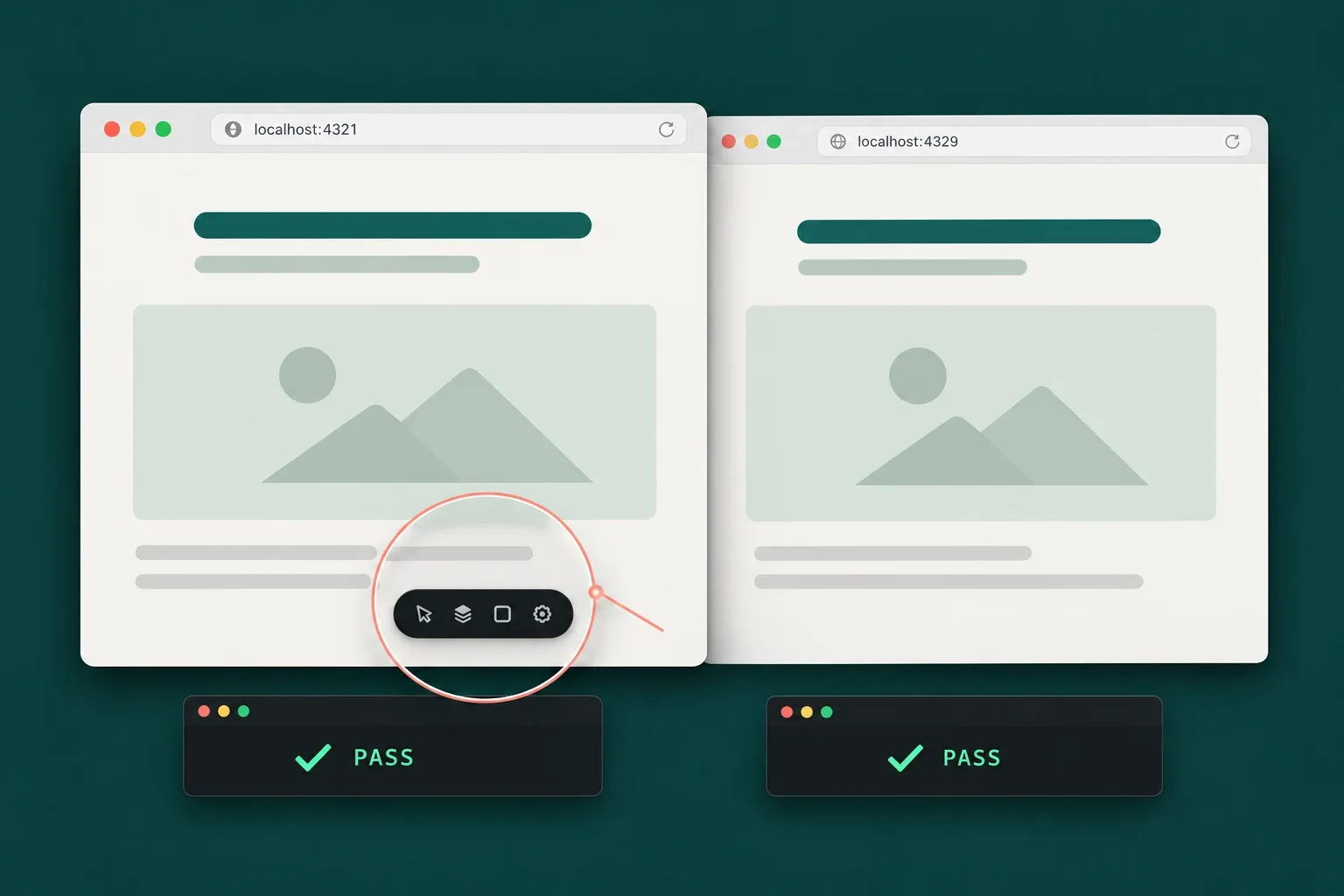
A mistake while building this website shows why automated checks and visual review belong together.
Task
Browser tests for this website: accessibility (axe), rendering on phones, content without JavaScript. They are meant to run against the finished static build, exactly what goes live.
What the agent built
A Playwright configuration that starts a preview server on port 4321 before the tests and reuses a server already running there. All tests passed.
The bug in it
At the same time, the development server was running on port 4321. The tests reused it and checked the development state instead of the build. Green only meant: the development server is fine.
How the process caught it
Before anything counts as done, I check it in the browser. The screenshots of the supposedly built site showed the development server’s toolbar, which does not exist in the build. Checking the port confirmed it.
Outcome
The tests now run on their own port and never reuse another server; a comment in the configuration records why. All tests were then run again against the build. The lesson: passing tests only prove something if it is clear what they checked.
Limits
Data, approvals and checks follow explicit rules throughout the workflow.
Data & secrets
Health data and customer data never go to an AI tool. Secrets live only in environment variables, never in code, the repo or a prompt.
Changes requiring approval
The agent asks before adding a production dependency, changing lockfiles, touching CI or infrastructure, deleting files or force-pushing.
Checks
Checks are never bypassed: no --no-verify, no @ts-ignore, no disabled lint rule just to make something pass. The agent fixes the cause or asks.
Commits & pushes
Commits and pushes happen only when I say so.
Mechanical guardrails
What can be checked mechanically is enforced by a guard hook in my workflow plugin: it blocks bypassed checks and secrets and asks before everything else happens.
Impact
OrthoOS
OrthoOS: in three months (07–09/2026), as founding engineer, I built a multi-tenant practice management platform, from row-level security and MFA to German dental billing formats and CI/CD.
This portfolio
This website: from first draft to a bilingual, tested site in one day. Build tests check SEO, structured data and internationalisation, plus browser tests with axe and Lighthouse budgets in CI.
Take the workflow with you.
Rules, guard hook and Codex agent as an installable Claude Code plugin, with tests and an example run:
git commit --no-verify Blocked
Checks must not be bypassed.
The guard matches patterns and is not a sandbox. It does not replace my review.